Featured Specialist: Dr. Erik Nielsen
Orthognathic surgery, also called corrective jaw surgery, repositions the upper jaw, lower jaw, or both to correct significant misalignments — including overbites, underbites, and cases where jaw position affects the airway or bite — that orthodontics alone cannot fully resolve. Common signs it may be worth an evaluation include chronic jaw pain, ongoing difficulty chewing, visible facial asymmetry, or bite problems that persist even after braces.
What Does Orthognathic Surgery Actually Correct?
Orthognathic surgery addresses structural misalignment of the jaw bones themselves, not just the position of individual teeth. Braces and clear aligners can move teeth within the jaw, but when the underlying jaw bones are too far forward, too far back, or uneven between the upper and lower arch, orthodontics alone often can’t fully correct the bite or facial balance. Corrective jaw surgery repositions the jaw bones to correct these deeper skeletal issues, which can include an overbite where the upper jaw sits too far forward, an underbite where the lower jaw protrudes, an open bite, a crossbite, or asymmetry between the two sides of the face. In many cases, it also improves the airway, since jaw position directly affects the space available for breathing, particularly during sleep.
What Signs Suggest You May Need Corrective Jaw Surgery?
Orthognathic surgery isn’t the right fit for everyone with a bite issue, but certain signs point toward a jaw alignment problem that orthodontics alone is unlikely to fully resolve:
- Chronic difficulty chewing or biting. If you struggle to comfortably chew certain foods, or your teeth don’t come together evenly when you bite down, the issue may be skeletal rather than something braces can fix on their own.
- Ongoing jaw pain or fatigue. Chronic jaw, joint, or muscle pain, especially if it persists despite other treatment, can sometimes be linked to how the jaws meet.
- Breathing or airway concerns. Some patients with a recessed lower jaw or narrow airway experience snoring, sleep-disordered breathing, or general breathing difficulty tied to jaw position.
- Visible facial asymmetry. A noticeably uneven jawline, chin that appears off-center, or imbalance between the upper and lower face can indicate a skeletal discrepancy.
- Bite problems that return or persist after braces. If your orthodontist has told you that braces alone won’t fully correct your bite, or your bite has relapsed after previous orthodontic treatment, that’s often a sign the jaw bones themselves need to be addressed.
- Lips that don’t close naturally at rest. Difficulty closing your lips comfortably without effort can sometimes point to a jaw position issue.
If several of these sound familiar, it’s worth having your bite and jaw alignment evaluated by an oral surgeon working alongside your orthodontist.
How Is a Skeletal Jaw Problem Actually Diagnosed?
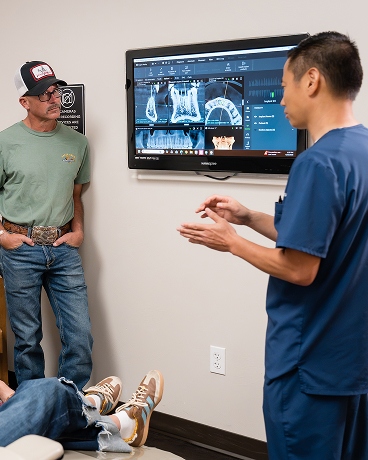
Because the signs above can also show up with less severe bite issues that orthodontics can resolve on its own, a proper diagnosis relies on more than a visual exam. Your oral surgeon will typically evaluate your facial proportions, review how your teeth meet when you bite down, and use in-house cone beam CT 3D imaging to see the exact position and relationship of your upper and lower jaw bones. This level of detail allows your surgical team to distinguish between a bite problem that’s limited to tooth position, which orthodontics can usually correct, and one that stems from the underlying jaw skeleton, which requires a surgical approach. Your orthodontist is often involved in this evaluation as well, since their assessment of what braces alone can and can’t achieve for your bite is a key part of the picture.
How Do an Orthodontist and Oral Surgeon Work Together on These Cases?
Corrective jaw surgery is almost always a collaborative process between your orthodontist and your oral and maxillofacial surgeon, since the two disciplines address different parts of the same problem. Your orthodontist typically manages the movement of your teeth within each jaw, aligning them so they’ll fit together properly once the jaw bones themselves are repositioned. Your oral surgeon is responsible for planning and performing the actual bone repositioning, working from shared imaging and treatment goals developed with your orthodontist.
This means the two providers are in regular communication throughout your treatment, coordinating the timing of orthodontic adjustments with the surgical plan so that your teeth and jaw bones arrive at the correct final position together. Because of this back-and-forth, orthognathic treatment is typically a multi-step process planned well in advance, rather than a single, isolated procedure.
What Does the Overall Process Look Like?
- Evaluation and imaging. Your oral surgeon evaluates your bite, jaw structure, and facial proportions, often using in-house cone beam CT 3D imaging to get a detailed view of your jaw bones and their relationship to one another.
- Collaborative treatment planning. Your surgeon and orthodontist work together to map out the full sequence, including any pre-surgical orthodontic work needed to align your teeth in preparation for surgery.
- Virtual surgical planning. Using advanced imaging and planning technology, your surgical team can map out the precise movements needed for your jaw bones before you ever reach the operating room, improving the predictability of your results.
- Pre-surgical orthodontics. In many cases, braces or aligners are used for a period of time before surgery to position the teeth correctly within each jaw.
- Surgery. Your oral surgeon repositions the jaw bone or bones according to the surgical plan, typically performed under general anesthesia.
- Recovery and follow-up. You’ll be closely monitored during initial healing, with your orthodontist typically resuming any remaining orthodontic treatment once your surgeon confirms you’re ready.
What Should You Expect During Recovery?
Recovery from orthognathic surgery takes real time, and patience during this stage supports a better final result. In general, patients can expect:
- Swelling and bruising. Facial swelling is common in the days following surgery and gradually improves over the following weeks.
- A modified diet. Most patients need to follow a liquid or soft-food diet for a period after surgery while the jaw begins to heal, gradually progressing back to a normal diet as directed by your surgeon.
- Activity restrictions. Rest and limited physical activity are typically recommended in the initial weeks of recovery to protect the surgical site.
- Follow-up appointments. Your surgical team will monitor your healing closely, and your orthodontist will typically be involved again as your bite continues to settle into its final position.
- A gradual return to normal function. Full healing of the jaw bone takes considerably longer than the initial recovery period, and your surgeon will guide you through each stage of returning to normal chewing and function.
Every patient’s timeline looks a little different depending on the extent of the surgery and their individual healing, so your surgical team will set expectations specific to your case.
Benefits of Corrective Jaw Surgery
Does Jaw Surgery Improve More Than Just Appearance?
- Improves bite function. Correcting the underlying jaw position allows your teeth to meet properly, making chewing more comfortable and even.
- Can improve breathing. Repositioning the jaw can increase airway space for some patients, which may help with breathing difficulties or sleep-related airway concerns.
- Reduces strain-related jaw pain. Addressing a significant skeletal misalignment can ease the chronic muscle and joint strain that sometimes comes with an uneven bite.
Does It Support Better Long-Term Oral Health?
- Creates a more stable, lasting bite correction. Because it addresses the jaw bones directly rather than just tooth position, orthognathic surgery tends to produce a more stable result than orthodontics alone in cases with true skeletal misalignment.
- Improves facial balance and symmetry. Repositioning the jaw bones often brings noticeable improvement to overall facial harmony as a natural result of correcting the underlying structure.
If you or your orthodontist suspect that your bite issue goes beyond what braces alone can correct, our board certified oral surgeons, including Dr. Erik Nielsen, who holds both a DDS and an MD, can evaluate whether corrective jaw surgery is right for you. If jaw joint symptoms are part of what you’re experiencing, our related guide on TMJ disorders is worth a look as well, since the two conditions are sometimes connected. Our team works closely with your orthodontist from initial imaging through recovery, helping you move toward a healthy, confident, beautiful smile with a bite that works the way it should. The next step is to schedule a consultation so we can evaluate your bite and jaw alignment together.
Frequently Asked Questions
Is jaw surgery only for cosmetic reasons?
No. While orthognathic surgery often improves facial balance as a result of correcting jaw position, it’s primarily a functional procedure aimed at correcting bite problems, chewing difficulty, and in some cases airway or breathing concerns. Any cosmetic improvement is generally a secondary benefit of addressing the underlying structural issue.
Do you need braces before or after jaw surgery?
Most patients need a period of orthodontic treatment both before and after surgery. Pre-surgical orthodontics aligns the teeth within each jaw in preparation for the bones to be repositioned, and post-surgical orthodontics fine-tunes the bite once the jaw has healed into its new position.
How long is recovery from orthognathic surgery?
Initial recovery, including significant swelling and dietary adjustments, generally spans the first few weeks after surgery, while complete healing of the jaw bone takes considerably longer. Your surgeon will give you a personalized recovery timeline based on the extent of your surgery.
Is corrective jaw surgery covered by medical or dental insurance?
Coverage can vary depending on whether the surgery is considered medically necessary and the specifics of your insurance plan, and some cases involve a combination of medical and dental benefits. Our team can help you understand what documentation your case may require and discuss your options as part of your treatment planning.
How do you know if your bite problem is skeletal rather than just a tooth alignment issue?
A thorough evaluation, including 3D imaging of your jaw bones and a review of your bite and facial proportions, is the most reliable way to tell the difference. Your orthodontist and oral surgeon will look at how your jaws relate to one another, not just how your teeth are positioned, to determine whether surgery is genuinely needed.
Can adults get corrective jaw surgery, or is it only for younger patients?
Orthognathic surgery is commonly performed on adults, and it’s typically recommended once jaw growth is complete, which is one reason it’s often considered in the late teen years or later. Many adults pursue jaw surgery specifically because bite or jaw alignment issues persisted or worsened after they stopped growing.
Will jaw surgery change how your face looks?
Repositioning the jaw bones often does change facial proportions to some degree, since the jaw plays a significant role in overall facial structure, but the primary goal is to correct bite and function rather than to reshape the face for its own sake. Most patients describe the resulting change in appearance as a natural improvement in balance rather than a dramatic transformation.