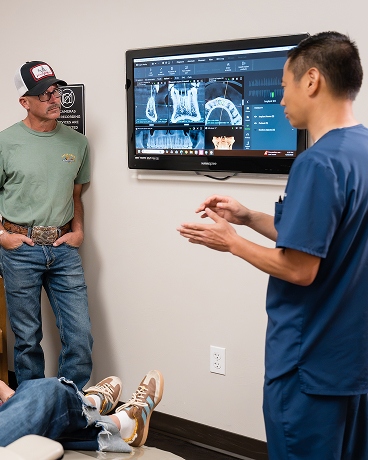


Featured Specialist: Dr. John Mizukawa
All-on-4 dental implants are permanently fixed to four implants anchored in your jawbone, while traditional dentures rest removably on your gums and are held in place with suction or adhesive. That difference drives nearly every other tradeoff between the two: stability, bone preservation, daily upkeep, and long-term cost. Traditional dentures are less invasive and lower cost upfront, while All-on-4 offers a fixed, more natural-feeling result that also helps protect your jawbone over time.
Both options are legitimate ways to restore a full arch of missing teeth, and neither is universally “better.” The right choice depends on your bone health, your budget, how much daily maintenance you are willing to take on, and how you feel about the idea of a permanent surgical solution versus a removable one. Below, we break down exactly how the two compare so you can have an informed conversation at your consultation.
All-on-4 vs. Traditional Dentures: A Side-by-Side Comparison
| Factor | All-on-4 Implants | Traditional Dentures |
|---|---|---|
| Stability & fit | Fixed permanently to implants; does not shift or slip | Rests on the gums; can loosen, shift, or click when speaking or eating |
| Bone preservation | Implants stimulate the jawbone, similar to natural tooth roots | Does not stimulate bone; jawbone often continues to shrink over time |
| Daily care & maintenance | Brush in place like natural teeth, plus recommended cleaning tools around the prosthesis | Must be removed, cleaned, and soaked daily; often requires adhesive |
| Adjustment period | A few weeks to adapt to speaking and eating with a fixed prosthesis after surgery and healing | Shorter initial adjustment, but ongoing relining/adjustments are often needed as the jaw changes shape |
| Typical longevity | Designed as a long-term, durable solution with proper maintenance and regular checkups | Often need relining, adjustment, or replacement over the years as the jawbone changes |
| Relative cost | Higher upfront investment; financing options available | Lower upfront cost, though ongoing adjustments and eventual replacement add up over time |
Who Tends to Be a Better Candidate for All-on-4 vs. Dentures?
Traditional dentures can be a reasonable option for patients who want a less invasive, lower-cost solution and are comfortable with the daily routine of removing and cleaning a removable appliance. They can also be appropriate as an interim solution while a patient decides on or prepares for a more permanent option.
All-on-4 tends to be the better fit for patients who want a fixed, non-removable result; who are frustrated with a denture that slips, clicks, or limits what they can eat; or who are concerned about the long-term bone loss that comes with wearing dentures for years. Because the All-on-4 technique uses angled implants to make efficient use of the bone that typically remains even after some loss, many patients who assume they do not have enough bone for implants turn out to be good candidates after a CBCT scan and clinical evaluation. Your surgeon will also consider your overall health and healing capacity, since All-on-4 involves a surgical procedure that traditional dentures do not.
Patients who are still deciding may also want to weigh lifestyle factors. If you travel frequently, work in a public-facing job, or simply do not want to think about removing and cleaning an appliance every night, a fixed solution tends to fit that lifestyle better. On the other hand, patients who are not ready for surgery, are managing a health condition that needs to be stabilized first, or want to test out a full-arch restoration before committing to implants sometimes start with dentures and revisit All-on-4 later.
How Long Does Treatment Take With Each Option?
Traditional dentures typically involve a shorter overall timeline. After any necessary extractions and gum healing, impressions are taken and the denture is fabricated and fitted, often within a matter of weeks. All-on-4 has a longer overall arc because it involves a surgical procedure: your consultation and CBCT imaging, a treatment-planning visit, surgery day itself (which includes placing a fixed temporary prosthesis), a healing period of several months for osseointegration, and finally your permanent restoration. The tradeoff is that All-on-4 patients are wearing fixed, functional teeth throughout that entire healing window, not waiting with no teeth at all.
It is also worth noting that traditional dentures are rarely a one-time purchase. As your jawbone continues to change shape after tooth loss, most denture wearers need periodic relines, adjustments, or eventually a full replacement denture, which adds appointments and cost over the years that are not always factored into the initial comparison.
How Does All-on-4 Address Common Denture Complaints?
Most patients who consider switching from dentures to All-on-4 treatment are motivated by a specific frustration. Here is how the two options compare on the most common ones.
What if my dentures keep slipping?
- Fixed anchoring solves the movement problem. Because All-on-4 is permanently attached to implants in the jawbone, it does not rely on suction, adhesive, or a precise gum-tissue fit the way removable dentures do.
What if dentures limit what I can eat?
- A more stable bite supports a broader diet. Many denture wearers avoid harder or chewier foods out of fear the denture will shift. A fixed All-on-4 prosthesis is anchored securely, which often allows for a wider range of foods once healing is complete.
What about the bone loss that happens over time?
- Implants help preserve jawbone. Dentures sit on top of the gums and do nothing to stimulate the bone underneath, which is a major reason jaws continue to change shape for years after tooth loss. All-on-4 implants function more like natural tooth roots, transmitting the everyday forces of biting and chewing into the bone.
What if I’m self-conscious about how my smile looks or sounds?
- A fixed prosthesis can restore confidence. Loose dentures can affect speech clarity and create anxiety about smiling or laughing in public. Because an All-on-4 arch does not move independently of your jaw, many patients find that both their speech and their comfort smiling improve once they are fully healed.
What Does Switching From Dentures to All-on-4 Involve?
If you currently wear dentures and are considering the switch, the process starts the same way it would for anyone else: a consultation with 3D CBCT imaging to evaluate your current bone volume and gum health. Because you have likely already lost some teeth and possibly some bone, your surgeon will pay close attention to how much bone remains and whether any additional planning is needed. From there, the process follows the same general path outlined in our full guide to the All-on-4 process: treatment planning, surgery day with implant placement and a fixed temporary prosthesis, a healing period of several months, and then your final permanent restoration.
One advantage for longtime denture wearers is that you already know what it is like to function without your natural teeth, which can make the adjustment to a fixed prosthesis feel like an upgrade rather than an entirely new experience. Many patients describe finally feeling secure biting into food they had avoided for years.
It is also common for longtime denture wearers to need a bone evaluation before moving forward, simply because bone naturally remodels over years of denture use. This is not a disqualifier for most patients, but it does mean your surgeon may spend extra time reviewing your CBCT scan to confirm the ideal implant positions and to rule out the need for any additional preparation before surgery day.
Both options can restore function and appearance, but they solve the problem in very different ways, and the right choice depends on your bone health, your daily frustrations with your current situation, and your long-term goals. The best way to know which path fits you is a hands-on evaluation with 3D imaging. Schedule a consultation with our team to discuss whether All-on-4 or dentures make the most sense for your smile.
Frequently Asked Questions
Can I still get All-on-4 if I already wear dentures?
In many cases, yes. Even patients who have worn dentures for years and experienced some bone loss can be candidates for All-on-4, since the technique is designed to make efficient use of the bone that typically remains. Your surgeon will confirm candidacy with a CBCT scan and clinical exam.
Does insurance cover All-on-4 or traditional dentures?
Dental insurance coverage varies widely by plan and provider, and some plans offer partial coverage for dentures while covering little to none of implant-based treatment, or vice versa. Our team can help you understand your specific benefits and discuss financing options during your consultation.
How long do dentures last compared to All-on-4?
Traditional dentures often need relining, adjustment, or full replacement over the years as your jawbone continues to change shape after tooth loss. All-on-4 is designed as a long-term, fixed solution, and with proper maintenance and regular checkups, many patients keep their results for many years.
Is All-on-4 surgery painful?
Surgery is performed under anesthesia or sedation, so you should not feel pain during the procedure itself. Afterward, most patients experience swelling and soreness similar to other oral surgeries, typically managed with prescribed or over-the-counter pain medication during the first week or two.
Will my speech be affected by All-on-4 versus dentures?
Any new dental prosthesis, whether removable dentures or a fixed All-on-4 arch, requires a short adjustment period for speech. Many patients find that because All-on-4 is fixed in place and does not shift the way a denture can, speech actually feels more natural once the adjustment period is complete.
Can I switch back to dentures after getting All-on-4?
All-on-4 is intended as a permanent, fixed solution, so switching back to removable dentures is not the typical path forward. This is one of the reasons a thorough consultation and candidacy evaluation upfront are so important before committing to treatment.
Is All-on-4 more expensive than dentures in the long run?
The upfront cost of All-on-4 is higher than traditional dentures, but dentures often come with recurring costs over the years for relines, adjustments, and eventual replacement as your jawbone changes shape. Many patients find it helpful to think about total cost of ownership over time rather than only the initial price, and our team can walk through financing options during your consultation.
Do I need a certain amount of jawbone for All-on-4?
Some bone volume is needed to support the four implants, but the technique is specifically designed to work with the denser bone that often remains even after years of tooth loss or denture wear. A CBCT scan during your consultation is the only reliable way to know whether you have enough bone or would benefit from additional planning.