

Curious whether you’re a good candidate for dental implants? Knowing the answer before you commit to treatment helps you plan with confidence and avoid surprises. This guide walks you through what makes someone an ideal candidate, how the evaluation works, and the 7 questions you should bring to your consultation at Southwest Oral Surgical Arts (SWOSA).
What Makes Someone a Good Candidate for Dental Implants?
A good candidate for dental implants is generally an adult with one or more missing teeth, healthy gums, sufficient jawbone to support an implant, and good overall health. Most patients qualify after a thorough evaluation, though uncontrolled diabetes, heavy smoking, or untreated gum disease can affect eligibility. A consultation with a board certified oral surgeon confirms candidacy.
Beyond those baseline factors, candidacy comes down to the details of your specific case. If you’ve been missing a tooth for years, some bone loss in that area is common, and your surgeon will measure whether enough bone remains, or whether a graft can rebuild what’s needed. Patients with well-managed chronic conditions can still be excellent candidates, especially when their physician and oral surgeon coordinate care.
Age is rarely a disqualifier on its own. We’ve placed implants for patients in their 30s and patients in their 80s. What matters more is healing capacity, oral hygiene habits, and a willingness to follow post-surgical instructions. Grind your teeth at night? That’s something we’ll plan around, not a reason to rule out implants entirely.
At SWOSA, our board certified oral surgeons and board certified periodontist evaluate each case individually. You may feel uncertain about your eligibility before walking in, but most patients leave the consultation with a clear answer and a defined plan for moving forward.
How the Dental Implant Candidacy Evaluation Works
The dental implant candidacy evaluation includes a clinical exam, 3D CBCT imaging, a full medical history review, and detailed treatment planning. Your surgeon measures bone density and volume at the implant site, checks gum health, and maps the position of nerves and sinuses. If bone is insufficient, preparatory procedures like grafting or a sinus lift may be recommended first.
Here’s what to expect, step by step:
- Clinical exam. Your surgeon evaluates remaining teeth, gum tissue, bite alignment, and the area where the implant will be placed.
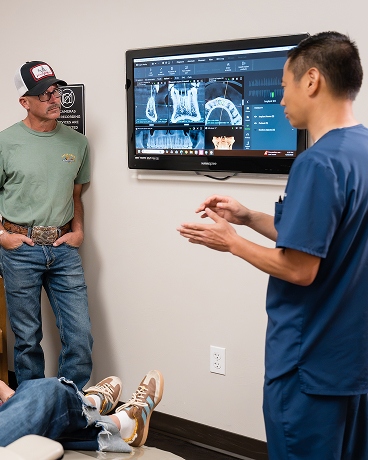
- 3D CBCT imaging. This imaging produces a detailed three-dimensional view of your jaw, showing exactly how much bone is available and where vital structures sit.
- Medical history review. We discuss medications, chronic conditions, and lifestyle factors that could influence healing.
- Treatment planning. Your surgeon outlines the number of implants needed, whether preparatory procedures are necessary, and the projected timeline.
- Cost and scheduling discussion. You’ll leave with a written treatment plan and an understanding of financing options.
When grafting or a sinus lift is needed, those procedures typically heal for several months before implant placement. From consultation to final restoration, most cases take between four and twelve months, depending on whether bone work is required. Straightforward single-implant cases often move faster. Full-arch restorations involve more stages and a longer overall timeline.
This process gives you a plan based on your anatomy, with each recommendation grounded in your actual jaw structure rather than a generic treatment template.
Benefits of Knowing Your Candidacy Before Treatment
Understanding your candidacy upfront changes how you experience the entire process. Instead of guessing, you get a clear picture of what’s possible, including the cost, the timeline, and any preparatory work you may need before implant placement begins.
Why does confirming candidacy build confidence?
When your surgeon confirms you’re a strong candidate, you can move forward without second-guessing. Early imaging catches issues like thin bone or sinus proximity before they turn into mid-treatment complications. Knowing whether you need a graft or sinus lift also means your quoted cost reflects the full scope of care, not a partial estimate that grows later.
What long-term benefits do implants offer?
- Preservation of bone and facial structure. Implants stimulate the jawbone the way natural tooth roots do, helping prevent the bone loss that follows tooth extraction.
- A permanent, natural-looking result. Unlike removable dentures or bridges that rely on adjacent teeth, implants stand on their own and look like the teeth you were born with.
- Improved chewing and speech. Patients consistently report eating foods they’d avoided for years and speaking without the slip of a denture.
There’s also the practical benefit of identifying preparatory procedures early. Need a bone graft? Knowing now means you can plan your time and budget around it instead of being told mid-treatment. Early candidacy review is one of the most valuable parts of working with board certified oral surgeons and periodontist who specialize in implant cases.
Dental Implants vs. Alternatives: What If Implants Aren’t Right for You?
If implants aren’t the right fit immediately, you still have options. And in many cases, what makes a patient a non-candidate today can be corrected with preparatory work.
| Option | Typical Longevity | Bone Health Impact | Adjacent Teeth Affected | Relative Cost |
|---|---|---|---|---|
| Single Dental Implant | Often lifetime with proper care | Preserves bone | No | Higher upfront, lower lifetime |
| All-on-4® | Long-term, full-arch solution | Preserves bone | No | Higher upfront |
| Traditional Bridge | Roughly a decade or more | Bone loss continues | Yes, requires grinding | Moderate |
| Removable Denture | Several years before replacement | Bone loss continues | Possible irritation | Lower upfront, ongoing replacement |
Bridges and dentures can restore appearance and basic function, but neither stops the bone loss that happens after teeth are lost. Over time, that bone loss changes facial structure and can make future implant treatment more complicated.
For patients missing most or all teeth in an arch, the All-on-4® technique is often a strong option, even when bone volume is limited. Four strategically placed implants support a full set of replacement teeth, giving patients a fixed solution without the need for extensive grafting in many cases.
When bone is the limiting factor, grafting can rebuild what’s missing. A patient who isn’t a candidate today may be a strong candidate six months after a graft heals. Your surgeon will guide you through whether grafting is worth the additional time and investment given your goals.
Cost Factors That Affect Dental Implant Candidacy
Dental implant cost depends on the number of implants needed, whether bone grafting or a sinus lift is required, the type of anesthesia used, and the complexity of the final restoration. A single implant costs less than full-arch restoration with All-on-4®, and preparatory procedures add to the total investment. Most practices offer financing to spread the cost over time.
The biggest cost drivers include:
- Number of implants. One implant for a single missing tooth costs significantly less than four implants supporting a full arch.
- Preparatory procedures. Bone grafting and sinus lifts add both time and expense, but they often make implants possible for patients who otherwise couldn’t have them.
- Anesthesia. Local anesthesia is included in most cases, while IV sedation or general anesthesia for longer procedures adds to the total.
- Restoration type. The crown, bridge, or full-arch prosthesis attached to your implants represents a meaningful portion of the overall cost.
Insurance coverage for implants varies widely. Some plans cover a portion of the surgical placement, while others contribute toward the restoration. At Southwest Oral Surgical Arts, financing is available to help patients spread the cost of smile restoration over time. Our team reviews coverage and payment options during your consultation so you know exactly what to expect.
7 Questions to Ask Your Oral Surgeon About Implant Candidacy
A consultation is your opportunity to get clear, specific answers about your case. Bring these seven questions with you, and you’ll leave knowing whether you’re a good candidate for dental implants and what comes next.
- Am I a good candidate based on my bone, gums, and overall health? Ask your surgeon to walk you through what the imaging shows, including whether your bone volume, gum health, and medical history support placement or call for preparatory work first.
- How many implants will I need, and where will they be placed? A single missing tooth needs one implant. A full arch may need four to six. Knowing the number sets expectations for both timeline and cost.
- What alternatives should I consider if implants aren’t right for me? Even if you’re a candidate, it helps to understand the trade-offs of bridges, dentures, and All-on-4®, and why your surgeon recommends implants for your situation.
- What is the full treatment timeline, including healing at each stage? Implant treatment moves in stages: extraction if needed, possible grafting, placement, healing, abutment, and final restoration. Ask for a realistic timeline you can plan around.
- What will my temporary teeth look like during treatment? Most patients don’t realize they won’t go without teeth during healing. Ask whether you’ll receive a temporary crown, bridge, or denture, and how it will look and feel.
- What type of anesthesia or sedation is recommended for my case? Local anesthesia, IV sedation, and general anesthesia all serve different purposes. Knowing which is recommended, and why, helps you prepare for the procedure.
- What are the financing options, and what does my insurance cover? Implants represent a long-term investment, and understanding payment options upfront removes financial uncertainty. Ask for a written treatment plan with itemized costs and financing details.
Bringing these questions to your consultation shows you’re an engaged patient, and it helps your surgeon give you the most useful, specific guidance. At SWOSA, our board certified oral surgeons and board certified periodontist welcome these conversations and will happily review your case in detail. The clearest way to answer “Am I a good candidate for dental implants?” is to sit down with a board certified oral surgeon, review your imaging, and map out a plan built around your needs and goals. Once you have that plan in hand, you can move toward a healthy, confident, beautiful smile with full confidence in every step ahead.
Frequently Asked Questions About Dental Implant Candidacy
Can I get dental implants if I have bone loss?
Yes, in many cases. Bone loss is common after tooth extraction, but bone grafting can rebuild the volume needed to support an implant. For patients with significant loss in the upper jaw, a sinus lift may also be recommended. Your surgeon will use 3D imaging to determine exactly what’s needed before recommending a treatment plan.
How long does the dental implant process take from start to finish?
The full process typically takes between four and twelve months, depending on whether preparatory procedures are needed. Straightforward single-implant cases often complete in four to six months. Cases involving bone grafting or sinus lifts take longer because the graft needs time to heal before the implant is placed. Your surgeon will provide a specific timeline at your consultation.
Are dental implants painful?
Dental implant placement is performed under local anesthesia or sedation, so you don’t feel the procedure itself. After surgery, most patients report mild to moderate soreness for a few days, managed with prescribed or over-the-counter medication. Recovery is generally well tolerated, and patients often return to normal activities within a day or two.
Can smokers or people with diabetes get dental implants?
Yes, but additional planning is involved. Smoking slows healing and increases the risk of implant failure, so surgeons often recommend cutting back or quitting before and after treatment. Patients with well-controlled diabetes are typically good candidates. Uncontrolled diabetes raises healing concerns, which is why your surgeon will review your medical history carefully during evaluation. If you’re ready for clear answers about your own candidacy, schedule a consultation with our team and we’ll walk you through the next steps toward a healthy, confident, beautiful smile.